the alchemist
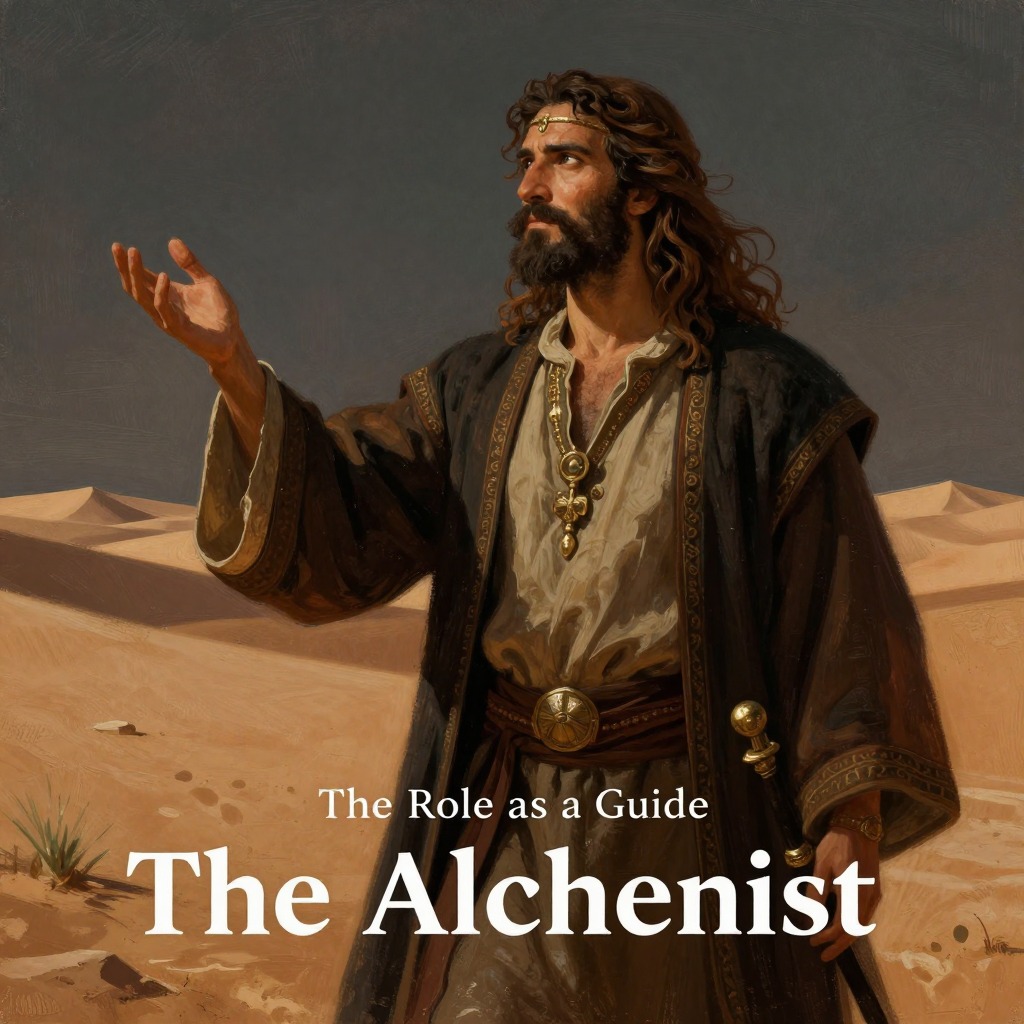
The alchemist is the most enigmatic and powerful mentor Santiago encounters on his journey. First appearing as a black-clad horseman astride a white horse, with a falcon on his shoulder and a curved sword, he tests Santiago's courage and then becomes his guide across the desert. He is said to be over two hundred years old, possessing the Philosopher's Stone and the Elixir of Life, and he understands the Language of the World. His role is not to teach Santiago new secrets but to point him toward the knowledge he already carries within himself, culminating in the lesson that the true treasure lies in the journey and in listening to one's heart.
Identity and First Encounter
The alchemist is introduced not as a scholar in a laboratory but as a figure of the desert, a horseman in black whose presence is more powerful than that of a mere messenger. He appears to Santiago on the night after the boy has warned the oasis of an impending attack, emerging from a dust storm on an enormous white horse. He draws a curved sword and presses its point to Santiago's forehead, drawing blood, and demands to know who dares to read the meaning of the flight of the hawks. This violent test is actually a trial of courage, which the alchemist declares "the quality most essential to understanding the Language of the World." He tells Santiago that he must love the desert but never trust it completely, because the desert tests all men and kills those who become distracted. After this encounter, Santiago realizes he has met the alchemist.
Role as Mentor and Guide
The alchemist's role is to guide Santiago toward his destiny, not by imparting new information but by helping him recognize what he already knows. When Santiago asks to be instructed, the alchemist replies, "You already know all you need to know. I am only going to point you in the direction of your treasure." He echoes the words of the old king Melchizedek, saying that when a person really desires something, all the universe conspires to help that person realize his dream. The alchemist teaches Santiago that the only way to learn is through action, and that everything he needs to know he has already learned through his journey. He instructs Santiago to listen to his heart, because it knows all things, having come from the Soul of the World. When Santiago's heart speaks of fear, the alchemist advises him to tell his heart that the fear of suffering is worse than the suffering itself, and that no heart has ever suffered when it goes in search of its dreams.
The Transformation into the Wind
The most dramatic demonstration of the alchemist's teachings occurs when Santiago is captured by a hostile tribe and ordered to turn himself into the wind or face death. The alchemist tells the chief that Santiago is an alchemist who understands the forces of nature and can destroy the camp with the force of the wind, buying three days for the boy to perform the miracle. When Santiago protests that he has no idea how to do this, the alchemist responds, "If a person is living out his destiny, he knows everything he needs to know. There is only one thing that makes a dream impossible to achieve: the fear of failure." He adds that dying in the midst of trying to realize one's destiny is better than dying like millions who never knew their destinies. During the three days, the alchemist feeds his falcon and remains calm, telling Santiago, "You're the one who may die. I already know how to turn myself into the wind." Santiago ultimately succeeds by communing with the desert, the wind, the sun, and finally the Hand that Wrote All, reaching through to the Soul of the World and performing the miracle.
Demonstration of Alchemy and Departure
After the transformation, the alchemist leads Santiago to a Coptic monastery, where he performs a literal demonstration of alchemy. Using a kitchen fire, an iron pan, and a sliver from the Philosopher's Stone, he turns lead into gold. He divides the gold disk into four parts: one for the monk, one for Santiago to replace what he gave the general, one for himself, and a fourth for Santiago in case he ever needs it, citing a proverb that "everything that happens twice will surely happen a third time." Before parting, the alchemist tells Santiago a story about a Roman centurion whose words became immortal, concluding that "no matter what he does, every person on earth plays a central role in the history of the world. And normally he doesn't know it." He then bids Santiago farewell, returning to the desert where tribal wars continue.
Thematic Significance
The alchemist embodies the novel's central philosophy: that the journey toward one's destiny is itself the treasure, and that the ultimate goal is not material wealth but spiritual evolution. He represents the culmination of Santiago's education, synthesizing the lessons of the old king, the crystal merchant, the Englishman, and the camel driver. His own life demonstrates that true alchemy is not about turning lead into gold but about transforming oneself. He tells Santiago that the alchemists who failed were those who sought only gold, not those who sought to live out their destiny. The alchemist's final gift is not the gold he creates but the wisdom he imparts: that love never keeps a man from pursuing his destiny, and that the Soul of the World is nourished by the pursuit of one's Personal Legend.